 Add to Chrome
 Add to Firefox
 Add to Edge
Foundation Protocol: A Coordination Layer for Agentic Society
May 22, 2026
Autonomous agents are moving from tools into a layer of social infrastructure: they browse, purchase, deploy software, manage systems, and increasingly interact with one another. As these systems scale, the bottleneck shifts away from raw model capability toward coordination. Agents need to form reliable relationships, organize multi-agent work, exchange value, support an AI economy, and stay safe and accountable under real-world oversight. This paper introduces the Foundation Protocol (FP), a graph-first coordination layer for an emerging human-AI society. FP unifies heterogeneous entities, including agents, tools, resources, humans, institutions, and organizations, and supports native multi-party organization and event-based collaboration. It also provides economic primitives for metering, receipts, and settlement, and treats policy, provenance, and audit as first-class concerns. FP is designed to wrap and bridge existing protocols rather than replace them, enabling incremental adoption while reducing integration and governance overhead. The aim is to keep autonomous agency composable while keeping accountability non-negotiable, so that coordination itself can become shared infrastructure for a human-AI society that is open, pluralistic, and governable.

Scalable Environments Drive Generalizable Agents
May 18, 2026Generalizable agents should adapt to diverse tasks and unseen environments beyond their training distribution. This position paper argues that such generalization requires environment scaling: expanding the distribution of executable rule-sets that agents interact with, rather than only increasing trajectories or tasks within fixed benchmarks. Current scaling practices largely focus on collecting more experience or broader task sets under fixed interaction rules, leaving agents brittle when underlying interfaces, dynamics, observations, or feedback signals change. The core challenge is therefore a world-level distribution shift: agents need systematic exposure to environments with meaningfully different executable rule-sets. To clarify this challenge, we propose a unified taxonomy that separates trajectory scaling, task scaling, and environment scaling by their primary deliverables and by what changes in the executable rule-set. Building on this taxonomy, we synthesize construction paradigms for scalable environments, contrasting programmatic generators that prioritize controllability and verifiability with generative world models that offer broader coverage and open-endedness. We further outline how environment scaling can be coupled with stateful learning mechanisms, emphasizing learned update rules for cross-environment adaptation. We conclude by discussing alternative perspectives and argue that scalable environments provide the essential substrate for measurable and controllable progress toward robust general agents.
KairosVL: Orchestrating Time Series and Semantics for Unified Reasoning
Feb 24, 2026Driven by the increasingly complex and decision-oriented demands of time series analysis, we introduce the Semantic-Conditional Time Series Reasoning task, which extends conventional time series analysis beyond purely numerical modeling to incorporate contextual and semantic understanding. To further enhance the mode's reasoning capabilities on complex time series problems, we propose a two-round reinforcement learning framework: the first round strengthens the mode's perception of fundamental temporal primitives, while the second focuses on semantic-conditioned reasoning. The resulting model, KairosVL, achieves competitive performance across both synthetic and real-world tasks. Extensive experiments and ablation studies demonstrate that our framework not only boosts performance but also preserves intrinsic reasoning ability and significantly improves generalization to unseen scenarios. To summarize, our work highlights the potential of combining semantic reasoning with temporal modeling and provides a practical framework for real-world time series intelligence, which is in urgent demand.
AutoWebWorld: Synthesizing Infinite Verifiable Web Environments via Finite State Machines
Feb 15, 2026The performance of autonomous Web GUI agents heavily relies on the quality and quantity of their training data. However, a fundamental bottleneck persists: collecting interaction trajectories from real-world websites is expensive and difficult to verify. The underlying state transitions are hidden, leading to reliance on inconsistent and costly external verifiers to evaluate step-level correctness. To address this, we propose AutoWebWorld, a novel framework for synthesizing controllable and verifiable web environments by modeling them as Finite State Machines (FSMs) and use coding agents to translate FSMs into interactive websites. Unlike real websites, where state transitions are implicit, AutoWebWorld explicitly defines all states, actions, and transition rules. This enables programmatic verification: action correctness is checked against predefined rules, and task success is confirmed by reaching a goal state in the FSM graph. AutoWebWorld enables a fully automated search-and-verify pipeline, generating over 11,663 verified trajectories from 29 diverse web environments at only $0.04 per trajectory. Training on this synthetic data significantly boosts real-world performance. Our 7B Web GUI agent outperforms all baselines within 15 steps on WebVoyager. Furthermore, we observe a clear scaling law: as the synthetic data volume increases, performance on WebVoyager and Online-Mind2Web consistently improves.
AOrchestra: Automating Sub-Agent Creation for Agentic Orchestration
Feb 03, 2026Language agents have shown strong promise for task automation. Realizing this promise for increasingly complex, long-horizon tasks has driven the rise of a sub-agent-as-tools paradigm for multi-turn task solving. However, existing designs still lack a dynamic abstraction view of sub-agents, thereby hurting adaptability. We address this challenge with a unified, framework-agnostic agent abstraction that models any agent as a tuple Instruction, Context, Tools, Model. This tuple acts as a compositional recipe for capabilities, enabling the system to spawn specialized executors for each task on demand. Building on this abstraction, we introduce an agentic system AOrchestra, where the central orchestrator concretizes the tuple at each step: it curates task-relevant context, selects tools and models, and delegates execution via on-the-fly automatic agent creation. Such designs enable reducing human engineering efforts, and remain framework-agnostic with plug-and-play support for diverse agents as task executors. It also enables a controllable performance-cost trade-off, allowing the system to approach Pareto-efficient. Across three challenging benchmarks (GAIA, SWE-Bench, Terminal-Bench), AOrchestra achieves 16.28% relative improvement against the strongest baseline when paired with Gemini-3-Flash. The code is available at: https://github.com/FoundationAgents/AOrchestra
Reasoning via Video: The First Evaluation of Video Models' Reasoning Abilities through Maze-Solving Tasks
Nov 19, 2025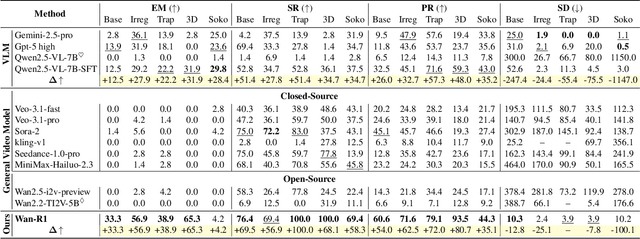
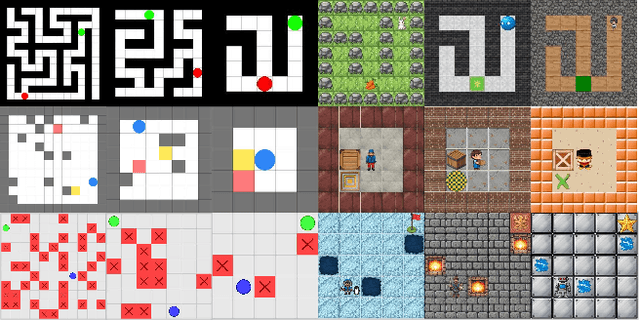
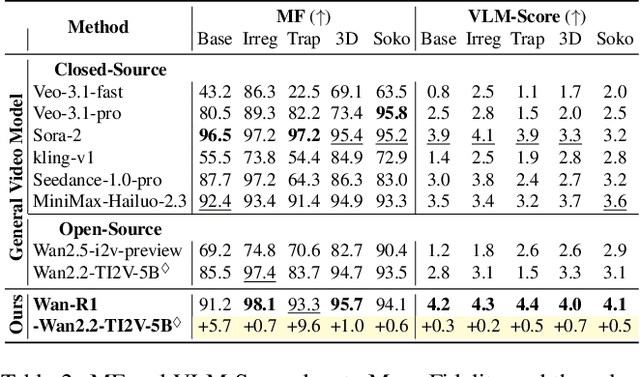
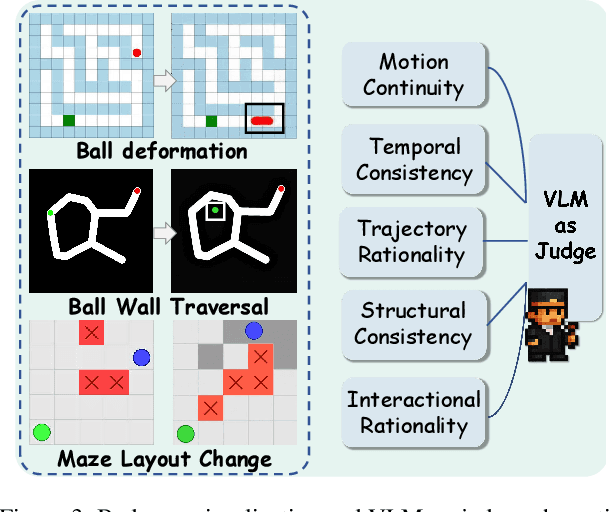
Video Models have achieved remarkable success in high-fidelity video generation with coherent motion dynamics. Analogous to the development from text generation to text-based reasoning in language modeling, the development of video models motivates us to ask: Can video models reason via video generation? Compared with the discrete text corpus, video grounds reasoning in explicit spatial layouts and temporal continuity, which serves as an ideal substrate for spatial reasoning. In this work, we explore the reasoning via video paradigm and introduce VR-Bench -- a comprehensive benchmark designed to systematically evaluate video models' reasoning capabilities. Grounded in maze-solving tasks that inherently require spatial planning and multi-step reasoning, VR-Bench contains 7,920 procedurally generated videos across five maze types and diverse visual styles. Our empirical analysis demonstrates that SFT can efficiently elicit the reasoning ability of video model. Video models exhibit stronger spatial perception during reasoning, outperforming leading VLMs and generalizing well across diverse scenarios, tasks, and levels of complexity. We further discover a test-time scaling effect, where diverse sampling during inference improves reasoning reliability by 10--20%. These findings highlight the unique potential and scalability of reasoning via video for spatial reasoning tasks.
TimeSense:Making Large Language Models Proficient in Time-Series Analysis
Nov 09, 2025In the time-series domain, an increasing number of works combine text with temporal data to leverage the reasoning capabilities of large language models (LLMs) for various downstream time-series understanding tasks. This enables a single model to flexibly perform tasks that previously required specialized models for each domain. However, these methods typically rely on text labels for supervision during training, biasing the model toward textual cues while potentially neglecting the full temporal features. Such a bias can lead to outputs that contradict the underlying time-series context. To address this issue, we construct the EvalTS benchmark, comprising 10 tasks across three difficulty levels, from fundamental temporal pattern recognition to complex real-world reasoning, to evaluate models under more challenging and realistic scenarios. We also propose TimeSense, a multimodal framework that makes LLMs proficient in time-series analysis by balancing textual reasoning with a preserved temporal sense. TimeSense incorporates a Temporal Sense module that reconstructs the input time-series within the model's context, ensuring that textual reasoning is grounded in the time-series dynamics. Moreover, to enhance spatial understanding of time-series data, we explicitly incorporate coordinate-based positional embeddings, which provide each time point with spatial context and enable the model to capture structural dependencies more effectively. Experimental results demonstrate that TimeSense achieves state-of-the-art performance across multiple tasks, and it particularly outperforms existing methods on complex multi-dimensional time-series reasoning tasks.
VisJudge-Bench: Aesthetics and Quality Assessment of Visualizations
Oct 25, 2025Visualization, a domain-specific yet widely used form of imagery, is an effective way to turn complex datasets into intuitive insights, and its value depends on whether data are faithfully represented, clearly communicated, and aesthetically designed. However, evaluating visualization quality is challenging: unlike natural images, it requires simultaneous judgment across data encoding accuracy, information expressiveness, and visual aesthetics. Although multimodal large language models (MLLMs) have shown promising performance in aesthetic assessment of natural images, no systematic benchmark exists for measuring their capabilities in evaluating visualizations. To address this, we propose VisJudge-Bench, the first comprehensive benchmark for evaluating MLLMs' performance in assessing visualization aesthetics and quality. It contains 3,090 expert-annotated samples from real-world scenarios, covering single visualizations, multiple visualizations, and dashboards across 32 chart types. Systematic testing on this benchmark reveals that even the most advanced MLLMs (such as GPT-5) still exhibit significant gaps compared to human experts in judgment, with a Mean Absolute Error (MAE) of 0.551 and a correlation with human ratings of only 0.429. To address this issue, we propose VisJudge, a model specifically designed for visualization aesthetics and quality assessment. Experimental results demonstrate that VisJudge significantly narrows the gap with human judgment, reducing the MAE to 0.442 (a 19.8% reduction) and increasing the consistency with human experts to 0.681 (a 58.7% improvement) compared to GPT-5. The benchmark is available at https://github.com/HKUSTDial/VisJudgeBench.
Advances and Challenges in Foundation Agents: From Brain-Inspired Intelligence to Evolutionary, Collaborative, and Safe Systems
Mar 31, 2025The advent of large language models (LLMs) has catalyzed a transformative shift in artificial intelligence, paving the way for advanced intelligent agents capable of sophisticated reasoning, robust perception, and versatile action across diverse domains. As these agents increasingly drive AI research and practical applications, their design, evaluation, and continuous improvement present intricate, multifaceted challenges. This survey provides a comprehensive overview, framing intelligent agents within a modular, brain-inspired architecture that integrates principles from cognitive science, neuroscience, and computational research. We structure our exploration into four interconnected parts. First, we delve into the modular foundation of intelligent agents, systematically mapping their cognitive, perceptual, and operational modules onto analogous human brain functionalities, and elucidating core components such as memory, world modeling, reward processing, and emotion-like systems. Second, we discuss self-enhancement and adaptive evolution mechanisms, exploring how agents autonomously refine their capabilities, adapt to dynamic environments, and achieve continual learning through automated optimization paradigms, including emerging AutoML and LLM-driven optimization strategies. Third, we examine collaborative and evolutionary multi-agent systems, investigating the collective intelligence emerging from agent interactions, cooperation, and societal structures, highlighting parallels to human social dynamics. Finally, we address the critical imperative of building safe, secure, and beneficial AI systems, emphasizing intrinsic and extrinsic security threats, ethical alignment, robustness, and practical mitigation strategies necessary for trustworthy real-world deployment.
Atom of Thoughts for Markov LLM Test-Time Scaling
Feb 17, 2025Large Language Models (LLMs) achieve superior performance through training-time scaling, and test-time scaling further enhances their capabilities by conducting effective reasoning during inference. However, as the scale of reasoning increases, existing test-time scaling methods suffer from accumulated historical information, which not only wastes computational resources but also interferes with effective reasoning. To address this issue, we observe that complex reasoning progress is often achieved by solving a sequence of independent subquestions, each being self-contained and verifiable. These subquestions are essentially atomic questions, relying primarily on their current state rather than accumulated history, similar to the memoryless transitions in a Markov process. Based on this observation, we propose Atom of Thoughts (AoT), where each state transition in the reasoning process consists of decomposing the current question into a dependency-based directed acyclic graph and contracting its subquestions, forming a new atomic question state. This iterative decomposition-contraction process continues until reaching directly solvable atomic questions, naturally realizing Markov transitions between question states. Furthermore, these atomic questions can be seamlessly integrated into existing test-time scaling methods, enabling AoT to serve as a plug-in enhancement for improving reasoning capabilities. Experiments across six benchmarks demonstrate the effectiveness of AoT both as a standalone framework and a plug-in enhancement. Notably, on HotpotQA, when applied to gpt-4o-mini, AoT achieves an 80.6% F1 score, surpassing o3-mini by 3.4% and DeepSeek-R1 by 10.6%. The code will be available at https://github.com/qixucen/atom.